Intelligent Audio-Text Digital Archiving System for Court Proceedings Documentation
DOI:
https://doi.org/10.71200/nexural.v1i1.269Keywords:
Audio-Text, Court Proceedings, Digital Archive, Intelligent System, WaterfallAbstract
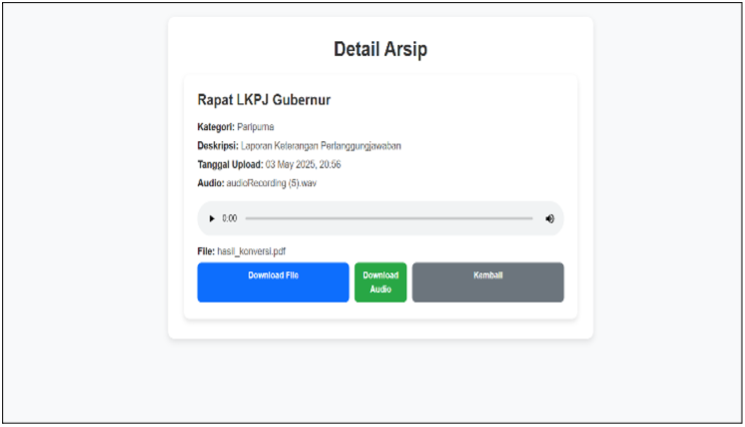
Court proceedings documentation plays a crucial role in preserving legal records and ensuring efficient access to judicial information. However, conventional documentation and archiving processes often rely on manual procedures, leading to inefficiencies, difficulties in information retrieval, and inconsistencies in records management. This study aims to develop an intelligent audio-text digital archiving system for court proceedings to improve the effectiveness and efficiency of judicial record management through the integration of audio and textual data. The system was developed using the waterfall software development model, which consists of the requirements analysis, system design, implementation, testing, and maintenance phases. The proposed system provides functionalities such as audio recording management, text-based documentation, digital data storage, indexing, and search capabilities to facilitate efficient access to archived records. System testing was conducted to evaluate the functionality and usability of the system in supporting court documentation activities. The results indicate that the developed system improves documentation efficiency, simplifies information retrieval, and enhances the accuracy and reliability of court records. Furthermore, the proposed system contributes to the digital transformation of judicial information management by providing a more structured, efficient, and intelligent archiving solution.
Downloads
References
J. Davet, B. Hamidzadeh, and P. Franks, “Archivist in the machine: paradata for AI-based automation in the archives,” Arch. Sci., vol. 23, no. 2, pp. 275–295, 2023, doi: 10.1007/s10502-023-09408-8. doi.org/10.1007/s10502-023-09408-8 DOI: https://doi.org/10.1007/s10502-023-09408-8
S. Ferro, M. Pelillo, and A. Traviglia, “AI-ASSISTED DIGITALISATION OF HISTORICAL DOCUMENTS,” Int. Arch. Photogramm. Remote Sens. Spat. Inf. Sci., vol. XLVIII-M-2–2023, pp. 557–562, 2023, doi: 10.5194/isprs-archives-XLVIII-M-2-2023-557-2023. doi.org/10.5194/isprs-archives-XLVIII-M-2-2023-557-2023 DOI: https://doi.org/10.5194/isprs-archives-XLVIII-M-2-2023-557-2023
S. Cameron, P. Franks, and B. Hamidzadeh, “Positioning Paradata: A Conceptual Frame for AI Processual Documentation in Archives and Recordkeeping Contexts,” J. Comput. Cult. Herit., vol. 16, no. 4, Nov. 2023, doi: 10.1145/3594728. doi.org/10.1145/3594728 DOI: https://doi.org/10.1145/3594728
G. Colavizza, T. Blanke, C. Jeurgens, and J. Noordegraaf, “Archives and {AI:} An Overview of Current Debates and Future Perspectives,” CoRR, vol. abs/2105.01117, 2021, [Online]. Available: https://arxiv.org/abs/2105.01117. doi.org/10.48550/arXiv.2105.01117
F. A. A.-Z. Mohamad Khairi Ishak Dag Øivind Madsen, “An Optimal Method for Speech Recognition Based on Neural Network,” Intell. Autom. & Soft Comput., vol. 36, no. 2, pp. 1951–1961, 2023, doi: 10.32604/iasc.2023.033971. doi.org/10.32604/iasc.2023.033971 DOI: https://doi.org/10.32604/iasc.2023.033971
J. Lehečka, “Transformer-based speech recognition models for oral history archives in English, German, and Czech,” 2023. doi.org/10.21437/Interspeech.2023-872 DOI: https://doi.org/10.21437/Interspeech.2023-872
T.-Y. Lee et al., “Machine learning-based speech recognition system for nursing documentation – A pilot study,” Int. J. Med. Inform., vol. 178, p. 105213, 2023, doi: https://doi.org/10.1016/j.ijmedinf.2023.105213. doi.org/10.1016/j.ijmedinf.2023.105213 DOI: https://doi.org/10.1016/j.ijmedinf.2023.105213
Y. He, K. P. Seng, and L. M. Ang, “Generative Adversarial Networks (GANs) for Audio-Visual Speech Recognition in Artificial Intelligence IoT,” Information, vol. 14, no. 10, 2023, doi: 10.3390/info14100575. doi.org/10.3390/info14100575 DOI: https://doi.org/10.3390/info14100575
W. Mardiati, S. Aisyah, N. Grataridarga, and R. Wulandari, “The Potential Use of Artificial Intelligence Technology in the Process of Collecting Metadata in Photo Archive Description Activities BT - Proceedings of the 6th International Conference on Vocational Education Applied Science and Technology (ICVEAST 2023),” 2023, pp. 918–931, doi: 10.2991/978-2-38476-132-6_78. doi.org/10.2991/978-2-38476-132-6_78 DOI: https://doi.org/10.2991/978-2-38476-132-6_78
M. Yildiz and F. Rukancı, “AI-driven transformation of audio archives: from speech recognition to NLP-based summarization and metadata generation,” Arch. Rec., vol. 47, no. 1, pp. 34–68, Jan. 2026, doi: 10.1080/23257962.2025.2560908. doi.org/10.1080/23257962.2025.2560908 DOI: https://doi.org/10.1080/23257962.2025.2560908
A. Saravanos and M. X. Curinga, “Simulating the software development lifecycle: The Waterfall model,” Appl. Syst. Innov., vol. 6, no. 6, p. 108, 2023. doi.org/10.3390/asi6060108 DOI: https://doi.org/10.3390/asi6060108
E. Rahmi, E. Yumami, and N. Hidayasari, “Analisis Metode Pengembangan Sistem Informasi Berbasis Website: Systematic Literature Review,” Remik Ris. dan E-Jurnal Manaj. Inform. Komput., vol. 7, no. 1, pp. 821–834, 2023. doi.org/10.33395/remik.v7i1.12177 DOI: https://doi.org/10.33395/remik.v7i1.12177
A. A. Khan, J. A. Khan, M. A. Akbar, P. Zhou, and M. Fahmideh, “Insights into software development approaches: mining Q &A repositories,” Empir. Softw. Eng., vol. 29, no. 1, p. 8, 2024. doi.org/10.48550/arXiv.2305.01315 DOI: https://doi.org/10.1007/s10664-023-10417-5
R. S. Pressman and B. R. Maxim, Software Engineering: A Practitioner’s Approach, 9th ed. McGraw-Hill Education, 2023.
I. Sommerville, Software Engineering, 11th ed. Pearson Education, 2023.
A. Perini, A. Susi, and J. Mylopoulos, “Requirements Engineering for Intelligent Systems,” Inf. Syst., 2023.
Published
Issue
Section
License
Copyright (c) 2026 Imam Solikin, Nasrullah Nasrullah (Author)

This work is licensed under a Creative Commons Attribution-ShareAlike 4.0 International License.